Have you ever wondered how to write paragraphs upon paragraphs of dissecting a character you love? Have you ever wanted to analyse your favourite character more in-depth alongside or instead of using fic to explore these characterisations? Here is a simple guide on how to start dipping your toes into that sort of thinking.
First, let's discuss how character analysis works.
Character analysis is the act of reading the text of your chosen media and applying them in an analytical manner to the character in question. It can be things like:
- visual framing
- colour choices
- dialogue
- narration
- actions and reactions
- theme music or musical motifs
- mechanics in their gameplay
- and more!
All of these pieces make up the character and can be used to interpret things about them, like how best they react or take action, what their frame of mind might be, and how they think of themself and their past. Every detail surrounding a character can inform your understanding of them, which is why many interpretations keep a general core similarity but vary in the minutia. The big and broad character beats, like their arcs in their media and their concrete traits, are what make up the basis of that character, after all, and ignoring those will often give you a completely different character.
Let's take Maya Fey from the Ace Attorney series for example. As shown in the text of the game, Maya is a brash, impulsive, and mischievous sort of character. She pulls silly pranks, says silly things, and helps the player and protagonist out of several jams. If you wrote her to be calm and polite and reserved, completely ignoring her traits shown in the canon text, then you'd be writing someone who resembles Susato Mikotoba, a character from a different game in the series, instead of the brash and impulsive and mischievous Maya Fey.
You might be saying to yourself, this is just character interpretation. What about character analysis, then? To which I will tell you, character analysis is the basis of character interpretation. You have to be able to see that the text of the media tells you how a character acts and thinks and reacts in order to analyse and interpret them.
Again, let's look at Maya Fey - we know she's the younger sister, in line to be the leader of her clan, and assists the protagonist Phoenix Wright during his courtroom trials. Taking these ideas into account can explain the traits she displays in her dialogue and actions: her penchant for mischief, her willingness to help others, and her impulsiveness. Her being the younger sibling can make her mischievous and impulsive tendencies make sense; she's got an older sibling who was the responsible one, allowing her to remain more childish. She is in line to be the leader of her clan, however, which we can see puts more responsibility on her shoulders than she's prepared for, thus her reluctance to give up these childish traits. And her willingness to help our protagonist can be read as showing her kindness. Or, it could be showing her desire to help others. Or that she's most comfortable remaining in that role of a younger sibling. It might even be fun to call it a mixture of all of the above.
So long as you can back your interpretation up with canon text, you can go wild in your analysis. You might see these things (younger sibling status, role of responsibility, helper to the protagonist) and see a whole other host of interpretations than the ones I've listed out, and that's okay. That's thinking on how to analyse the character for yourself, after all!
Next up, putting it into words.
Let's get into the meat of the idea here: writing pure character analysis. This can be surprisingly simple when taking the interpretation point into consideration; after all, if you have experience in writing this character in fics, then you've all ready formed an analysis of their basics. Finding the words may be the most difficult part of the process, as translating fiction writing into non-fiction can be tricky. So long as you remember that you have the basis for analysis down via interpretation, however, you should be able to handle switching over that interpretation into analysis. Think of it as explaining why you interpret and write the character in the ways that you do.
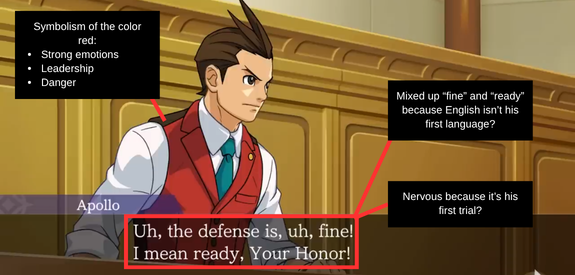
Let's use another character for our example: Apollo Justice, also from the Ace Attorney series. Apollo desires to be an attorney, is stubborn sometimes to the point of abrasiveness, and hopeful for validation on his goals. Based on the muddled text canon gives him, we can interpret his actions in a multitude of ways; his being an orphan is one way of explaining his abrasive, stubborn nature. His want to be a lawyer is another way to explain his eagerness for validation in his chosen career. He's shown to be studious and driven towards his goal of figuring out the truth, which can be explained by his seemingly absent mention of any support network in his life.
As you can see, explaining the character's traits with ideas from their backstories or the like makes them feel more fully rounded. It's similar to how our own experiences make up our opinions and tendencies; if you grew up near the ocean or in a desert, that might colour your opinion on swimming or rainfall. It's drawing logical conclusions from the given information mostly, and a little bit of imagination to connect the dots and form a full picture.
But how about taking an aspect of a character and expanding on it on its own? Instead of connecting it to their backstory, let's connect an aspect to the character's personality and the way they approach the problems in their lives. You can take any aspect and expand on it in this manner, from how they're framed (if in light, darkness, or always certain colours), a frequent phrase they say, the way they react to specific situations, their style of clothing; it can be literally any aspect. All of these give a lot of idea on how the author approached these characters and how you, as a fan author, can continue their characters.
For our example, let's take Apollo Justice again. He's known for being loud, even having his own vocal routine he lovingly calls his Chords of Steel. You can interpret this in a lot of ways; vocal training can help disguise an accent or gradually help shift the pitch of your voice, after all. He could be using this training to help him fit into his environment better. He also might be less self-conscious about taking up space, seeing as he's willing to be loud. Or, you can take it in the opposite direction and have him more self-conscious of how much space he takes up. You can connect his vocal training to his desire to be a lawyer and shout in the courtroom, to his being an orphan and having to fight for his goals, or even to his other mannerisms, like preferring to have his arms crossed and his straight man role in the comedy of his game.
As you can see, examining just one aspect can cascade into a whole other slew of observations and possibilities. There's a lot to be said about what traits a character has been given and how we see it serve them in the narrative they inhabit. Just so long as you can remember the most important question to ask yourself, you'll be able to analyse down to the smallest of aspects of your favourite characters.
What is that question? It is, of course,
What does this tell us about our character?
At the core of analysis, that's the main question we want to ask and do our best to answer. What can it tell us that this character has a fear of being abandoned? What does it tell us that this character is always in the shadows and framed in contrast to the light? What does it tell us that this character is always seen wearing the colour red?
Sometimes, the answers can be simple. Those simple answers, however, can open up into the next observation and inform the next aspect and so on until you have yourself a two thousand word essay on what family means to your character in question. Perhaps you'll even approach fic writing in a new and fun way as you continue poking and prodding at the characters you love. Perhaps it will even help you develop the skills in recognising your own original characters' idiosyncrasies! At the very least, I hope this opens up the gates for you to approach analysis with less apprehension.
In conclusion
Character analysis might first appear to be a strange beast to tackle, but it's manageable so long as you take it a step at a time. Starting small by diving into one aspect of a character can help demystify the process, especially if you're hungry for another method to explain how you interpret the things canon gives you about your favourites besides fic writing. Have fun out there practising to dissect your blorbos!